
The Rise of Artificial Intelligence & The Future of Human Innovation
Artificial Intelligence is rapidly transforming the way people live, work, communicate, and interact with technology. What once existed only in science fiction has now become one of the most influential technological advancements shaping modern society. From intelligent virtual assistants and autonomous systems to advanced data analysis and medical research, AI is changing industries at an unprecedented pace.
As computing power continues increasing and machine-learning systems become more sophisticated, Artificial Intelligence is moving beyond simple automation toward intelligent decision-making, predictive analysis, and adaptive learning. This evolution is creating new opportunities across healthcare, education, transportation, business, cybersecurity, and scientific research.
Artificial Intelligence is no longer just a technological tool — it is becoming a foundational part of how future societies will operate.
Understanding Artificial Intelligence
Artificial Intelligence refers to computer systems designed to perform tasks that normally require human intelligence. These systems can learn from data, recognize patterns, solve problems, understand language, and improve performance over time through continuous learning processes.
Modern AI technologies are powered by machine learning, neural networks, natural-language processing, and large-scale data analysis. These systems enable computers to process massive amounts of information faster and more accurately than traditional programming methods.
How AI Is Transforming Industries
AI is revolutionizing healthcare by assisting doctors in diagnosing diseases, analyzing medical images, and accelerating drug discovery. In transportation, intelligent systems are improving traffic management, autonomous driving, and logistics optimization.
Businesses are also adopting AI-powered tools for customer support, cybersecurity, marketing automation, financial forecasting, and operational efficiency. Educational platforms use AI to personalize learning experiences, helping students receive more adaptive and interactive educational support.
The rapid integration of Artificial Intelligence into everyday systems demonstrates how deeply intelligent technologies are becoming embedded into global infrastructure and digital environments.
The Future of Human & Machine Collaboration
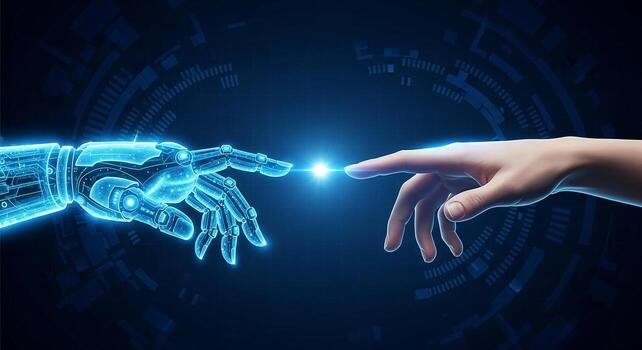
Rather than completely replacing humans, many experts believe the future of AI will focus heavily on collaboration between humans and intelligent systems. AI can automate repetitive tasks, analyze large datasets, and provide predictive insights, while humans continue contributing creativity, ethics, emotional intelligence, and strategic decision-making.
This collaboration could improve productivity, scientific discovery, healthcare accessibility, and technological innovation across nearly every sector of society. However, it also raises important discussions about privacy, ethics, job transformation, and responsible AI development.
Challenges & Ethical Considerations
As AI systems become more powerful, concerns surrounding data privacy, misinformation, algorithmic bias, and automation-related job disruption continue growing. Responsible AI development requires transparency, accountability, and ethical frameworks that ensure technology benefits society without creating harmful consequences.
Governments, researchers, and technology companies worldwide are actively working on policies and standards designed to balance innovation with safety, fairness, and long-term societal stability.
The Next Era of Innovation
Artificial Intelligence is expected to become one of the defining technologies of the 21st century. Future advancements may include highly advanced robotics, intelligent healthcare systems, smart cities, autonomous scientific research, and more sophisticated human-computer interactions.
As technology continues evolving, understanding Artificial Intelligence will become increasingly important for students, professionals, businesses, and society as a whole. The ability to adapt to intelligent technologies may shape the future of global innovation, economic growth, and human development.
Conclusion
Artificial Intelligence is not simply another technological trend — it represents a major transformation in how humans interact with machines, information, and the digital world. Its influence is already visible across industries and will continue expanding as innovation accelerates.
At InvestHighTech, we focus on simplifying complex technologies and helping readers understand the innovations shaping tomorrow’s world. Through educational insights, future-focused analysis, and simplified explanations, the platform aims to make emerging technologies more accessible to everyone interested in the future of innovation.
Leave a Reply